
Municipal rain barrel rebate programs have made it easy for many homeowners to get started with rainwater harvesting. A basic rain barrel is an affordable, low-effort way to capture roof runoff and reduce outdoor water consumption.
For properties with larger roofs, gardens, or longer dry spells between rain events, however, a standard rain barrel often fills quickly and provides limited long-term benefit. In those cases, increasing storage capacity can significantly improve performance and value.
This guide explains how rain barrels work, where they make sense, and when it’s worth planning for more storage.
A rain barrel is a small container connected to a roof downspout that captures rainwater as it runs off your roof. Most rain barrels hold between 150 and 300 litres and are commonly used for:
Rain barrels are popular because they are:
For properties with limited space and modest outdoor water needs, a rain barrel is a practical introduction to rainwater harvesting.
Southern Ontario receives regular rainfall throughout spring, summer, and fall. Even a modest residential roof can shed hundreds of litres of water during a single rain event.Without storage, that water is lost to runoff. Rain barrels allow homeowners to capture some of it, but storage capacity becomes the limiting factor quickly — especially on properties with larger roofs, gardens, or multiple downspouts.

Rain barrels are a good starting point, but they are not designed for high-volume capture.Common limitations include:
The amount of rainwater you can collect depends largely on roof area. Larger roofs generate far more runoff than a rain barrel can realistically store.
Matching storage capacity to roof size reduces overflow and makes better use of available rainfall.
Large rainwater storage tanks — often called cisterns — are designed to store hundreds to thousands of litres of rainwater. Percheron Plastic offers a broad range of vertical tanks that suit residential water harvesting and larger storage needs.These tanks are typically installed above ground and connected to one or more downspouts, either as a standalone system or as an upgrade from rain barrels.
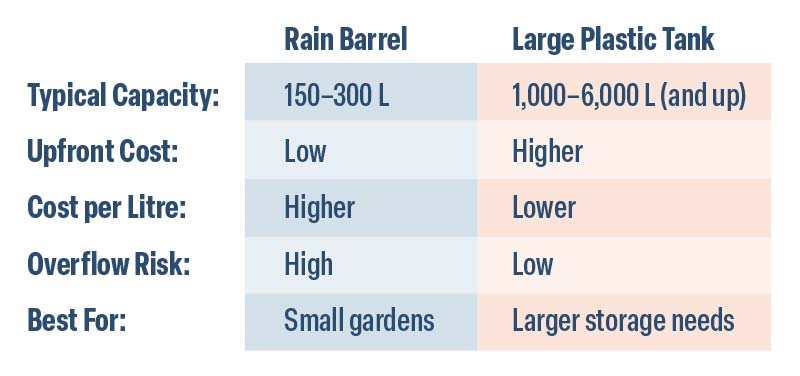
For homeowners who have already benefited from a rebate-supported rain barrel, increasing storage capacity can be the next logical step.
How much rainwater can I collect from my roof?
Even a modest residential roof can collect hundreds of litres from a single rainfall. Larger roofs paired with larger tanks allow more water to be stored instead of lost to runoff.
Are rain barrels worth it?
Yes. Rain barrels are an affordable, low-effort way to reduce municipal water use, especially when supported by rebate programs.
How much rainwater can I collect from my roof?
Even a modest residential roof can collect hundreds of litres from a single rainfall. Larger roofs paired with larger tanks allow more water to be stored instead of lost to runoff.
When should I consider a larger tank?
If your rain barrel fills quickly or overflows regularly, a larger storage tank offers better long-term value.
Can rainwater be used for drinking?
Rainwater is typically used for non-potable purposes unless treated with appropriate filtration and disinfection systems.

Percheron Plastic is here to help. Owners Matt Tanguay and Eric Quane are experts in plastic tanks. Along with sales associate Matthew Vallentgoed, they are happy to advise and discuss what you might need - in a guaranteed, non-pushy manner. With decades of experience, they'll make sure you're well informed.
Need a Tank? Have a question? Give Matthew Vallentgoed a call today: 1.800.780.3609 x: 100
1970 Brown Line, Cavan-Monaghan, ON, K9J 6Z9 Canada | +1.800.780.3609
Copyright © 2021 Percheron Plastic Inc. All rights reserved. 100% Canadian.

